

In the Ultimate Guide to the Owls of the USA, we look at the 16 main owl species found across the country. Owls occupy nearly every ecosystem in the United States, from Arctic tundra to desert grasslands. Learning to recognize their shapes, calls, and behaviors adds depth to any outdoor experience and reveals just how diverse and specialized these remarkable birds truly are.
The Ultimate Guide to Owls of the United States
If you step outside on a cool evening and listen carefully, you may hear a deep, rhythmic hoot drifting through the trees. That low call often belongs to one of North America’s most accomplished nocturnal predators. Owls are among the most fascinating birds on the continent, combining silent flight, specialized hunting skills, and remarkable adaptations for life after dark.
This comprehensive guide explores the primary owl species found in the United States. For each species, we highlight key identification traits, vocalizations, flight style, habitat preferences, and geographic range to help readers better recognize and understand these elusive birds.
Great Horned Owl
The Great Horned Owl (Bubo virginianus) is one of the most powerful and widespread owls in North America. It is easily recognized by its large size, prominent feathered ear tufts, piercing yellow eyes, and mottled brown and gray plumage. A bright white throat patch is often visible when the bird is calling, producing a deep, resonant hooting sequence.

In flight, its silhouette can resemble that of a Red tailed Hawk, with broad wings and a confident, direct glide. This species occupies nearly every habitat imaginable, including deserts, forests, wetlands, suburbs, and city parks. When a large owl crosses a roadway at night, this species is often responsible.

Barred Owl
Barred Owls (Strix varia) have a smooth, rounded head with no ear tufts and large, dark eyes that give them a gentle yet intense expression. Their plumage features vertical barring on the chest and horizontal streaking on the belly, creating the pattern that inspired their name.

Their call is well known, a rolling series of hoots commonly remembered as “Who cooks for you? Who cooks for you all?” In flight, Barred Owls appear broad winged and buoyant, gliding silently through mature forests. Once limited primarily to the eastern United States, they have expanded westward and now overlap with the range of the threatened Spotted Owl, creating a major conservation challenge.

Long Eared Owl
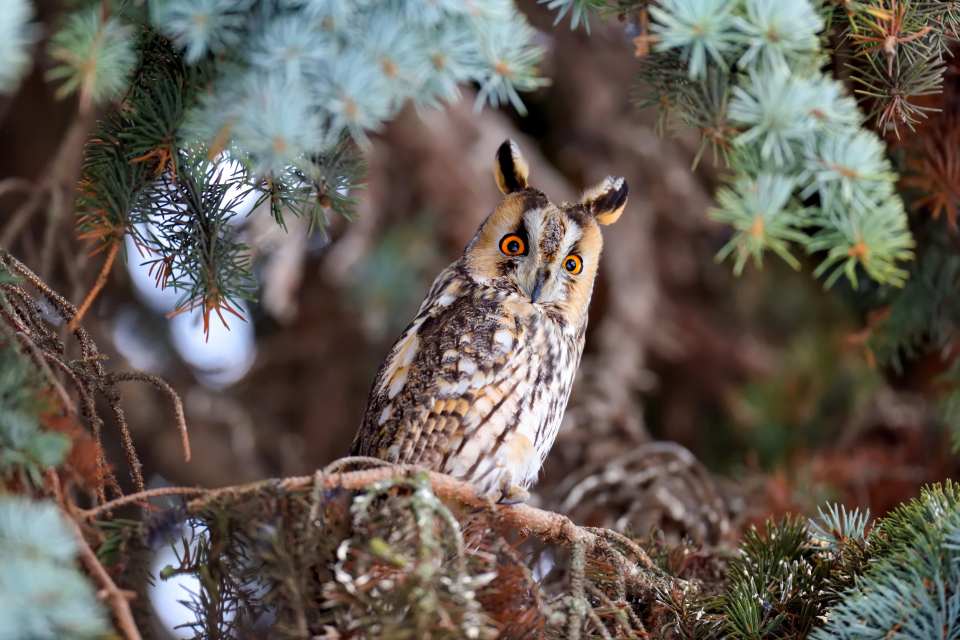
The Long Eared Owl (Asio otus) is a slim, slender species with tall, upright ear tufts and a strongly patterned facial disc. Its warm brown, buff, and black plumage provides exceptional camouflage among dense conifer branches.

This owl is highly secretive and often roosts motionless against tree trunks. During winter, multiple individuals may gather in communal roosts, sometimes with dozens occupying a single grove. Their calls consist of low, evenly spaced hoots, along with occasional squeals or barks. Long Eared Owls are extremely sensitive to disturbance and may abandon roosting sites if stressed.

Spotted Owl
The Spotted Owl (Strix occidentalis) has a rounded head without ear tufts, large dark eyes, and rich brown plumage marked with pale oval spots. Its softly defined facial disc and intricate patterning give it a solemn appearance.

Often confused with the Barred Owl, it can be distinguished by finer spotting and subtler facial markings. In flight, it appears broad winged and steady, gliding quietly through old growth forests. This species depends on deep shade, complex canopy structure, and undisturbed habitat, making it particularly vulnerable to forest loss.

Eastern Screech Owl
The Eastern Screech Owl (Megascops asio) is a small, stocky owl with prominent ear tufts, yellow eyes, and highly detailed plumage that blends seamlessly with tree bark. Individuals occur in gray or rufous color forms.

Despite the name, this species does not screech. Its most common vocalizations include a descending whinny and a soft, monotone trill. Agile and compact in flight, it moves quietly between tree cavities and low perches. Readily using nest boxes, it is one of the easiest owls to attract to suburban yards and is widespread across much of the eastern and central United States.

American Barn Owl
Barn Owls (Tyto furcata) are instantly recognizable by their pale, heart shaped facial disc, dark eyes, and long legged, slender build. Their plumage appears ghostly in low light, blending white, buff, and golden tones with fine speckling.

Instead of hooting, Barn Owls produce harsh, rasping screams. Their flight is exceptionally silent and buoyant as they hunt over open fields and farmland using sound alone. They often nest in barns, silos, abandoned buildings, and palm cavities. This species is widely distributed across the Americas wherever open habitat and nesting sites are available.

Short Eared Owl
Short Eared Owls (Asio flammeus) have rounded heads with barely visible ear tufts, bright yellow eyes, and streaked tawny plumage that blends into grasslands. They are frequently active at dawn and dusk, coursing low over open fields with a moth like flight pattern.

Unlike many owls, they often perch on the ground or low posts. Their calls are subtle, though males may produce soft barking notes during display flights. This species is found across large portions of North America and other continents, favoring prairies, marshes, tundra edges, and open grasslands.

Flammulated Owl
The Flammulated Owl (Psiloscops flammeolus) is a small, strictly nocturnal species with dark eyes and finely patterned gray plumage accented by rust colored streaks. Its understated appearance contrasts with many more boldly marked owls.

This owl feeds almost exclusively on insects, including moths and beetles. Its call is a low, single hoot repeated at regular intervals and is often heard before the bird is seen. It breeds in western montane forests and migrates south to Mexico and Central America during the non breeding season.

Elf Owl
The Elf Owl (Micrathene whitneyi) is the smallest owl in the world. It has a rounded head without ear tufts, yellow eyes, and warm mottled plumage. Strictly nocturnal, it is rarely observed during daylight hours.

These owls nest in tree cavities, cactus holes, and abandoned woodpecker nests. Their call is a rapid series of high pitched yipping notes. Agile and fast in flight, they hunt insects at night using speed rather than gliding. In the United States, they are found mainly in the desert regions of the Southwest.

Northern Saw whet Owl
The Northern Saw whet Owl (Aegolius acadicus) is a small, round headed owl with oversized yellow eyes and richly mottled brown plumage. Its compact shape and still roosting posture give it an almost toy like appearance.

It is best known for its steady, metronome like call that carries clearly through nighttime forests. In flight, it uses short bursts of rapid wingbeats as it hunts small mammals. This species breeds across Canada and the northern United States and winters farther south.

Northern Pygmy Owl
Despite its tiny size, the Northern Pygmy Owl (Glaucidium californicum) is a bold, aggressive hunter. It has a rounded head without ear tufts, bright yellow eyes, and brown plumage with fine white spotting.

One of its most distinctive features is the pair of black false eyes on the back of its head, which can confuse predators and prey alike. Unlike most owls, it is active during daylight hours and frequently hunts birds nearly its own size. It is found throughout western North America in mixed woodlands and montane forests.

Great Gray Owl
The Great Gray Owl (Strix nebulosa) is the tallest owl in North America and is recognized by its enormous facial disc, soft gray plumage, and long, tapered body. Despite its size, it is relatively lightweight and built for silent flight.

Its small yellow eyes sit deep within concentric rings of feathers, creating a striking, ghostlike appearance. It hunts by listening for rodents beneath snow and vegetation, often hovering briefly before striking. This species inhabits boreal and subalpine forests and is famous in wintering areas such as northern Minnesota.

Northern Hawk Owl
The Northern Hawk Owl (Surnia ulula) has a sleek, long tailed body and a hawk like silhouette. It lacks ear tufts and features finely barred brown and white plumage with piercing yellow eyes.

Unusual among owls, it is strongly diurnal and often hunts from exposed treetops in full daylight. Its fast, level flight further reinforces its hawk like behavior. It resides primarily in the boreal forests of Alaska and Canada, with occasional winter movements into the northern United States.

Boreal Owl
The Boreal Owl (Aegolius funereus) is a compact species with a large rounded head, sharply defined facial disc, and bright yellow eyes. Its mottled brown and white plumage provides excellent camouflage against conifer bark.

Strictly nocturnal and highly secretive, it roosts low in dense evergreen forests. Its clear, bell like call carries surprisingly far at night. In the United States, it is mainly found in Alaska and high elevation forests of the Rocky Mountains.

Snowy Owl
Snowy Owls (Bubo scandiacus) are large, powerful birds adapted for life in the Arctic. They are predominantly white, with varying amounts of dark barring, especially on females and younger birds.

Unlike many owls, they are often active during daylight hours and frequently perch in open areas. Their flight is strong and deliberate, suited for wide open landscapes. Snowy Owls breed on Arctic tundra and winter irregularly farther south, sometimes reaching the central United States during irruption years.

Burrowing Owl
The Burrowing Owl (Athene cunicularia) is a small, long legged owl with a rounded head, bright yellow eyes, and heavily patterned brown and white plumage. It is frequently active during the day and is often seen standing at the entrance of its burrow.

Its vocalizations include chatters, coos, and a distinctive hiss that mimics a rattlesnake to deter predators. In flight, it stays low with quick wingbeats and short glides. This species inhabits open grasslands, deserts, and prairies across western and central North America.

Related Articles




Ad Space


