

Species Guide: Great Horned Owl (Bubo virginianus)
Family: Strigidae
The Great Horned Owl is a large, widely distributed raptor native to the Americas. It occupies a wide variety of ecosystems from tundra edges in the north through temperate forests, deserts, agricultural lands, and urban parks to parts of Central and South America. Its adaptability, powerful hunting abilities, and prominent ear tufts make it one of the most recognizable North American owls.
Appearance
Male
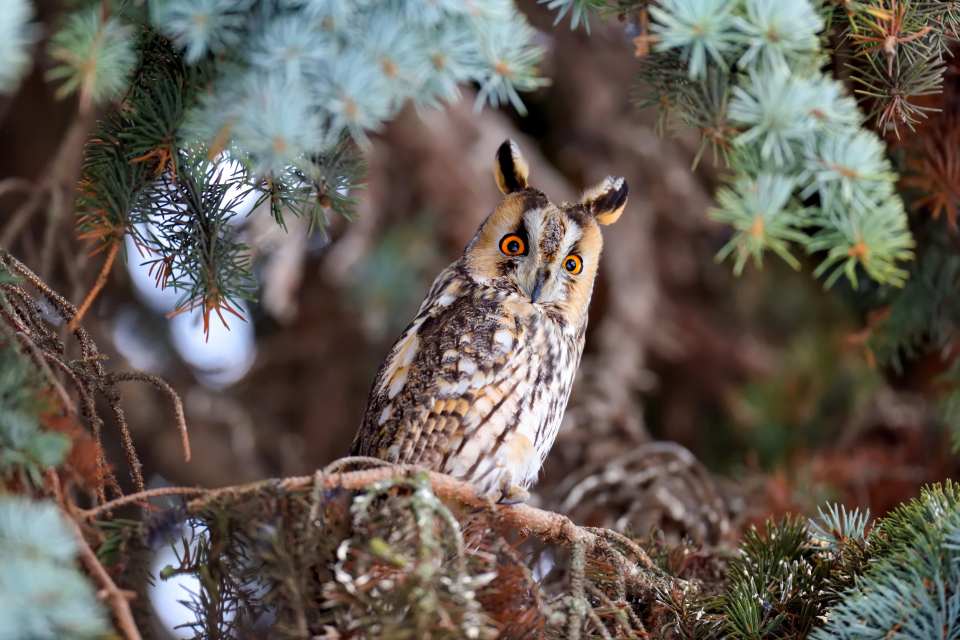
Adult male Great Horned Owls present a robust, heavily built silhouette with a large head and conspicuous ear tufts. Plumage is mottled gray-brown with a variable tone regionally; a pale facial disc framed by darker borders and a small white throat patch are typical. Male size varies with geography but is generally smaller than that of females.
Female
Females resemble males in plumage and patterning but are usually larger and heavier. This sexual size difference is common among raptors and is apparent in average weight and wing measures. Females commonly weigh more and may be the dominant sex at nests during territorial defense.

Juvenile
Juveniles show fluffier, softer plumage that lacks the full adult patterning and ear tuft definition. Their facial discs are less distinct, and overall coloration may appear more uniformly buff or cinnamon before the first full molt into adult plumage. Juveniles depend on parents for food for several weeks after fledging.

Diet
The Great Horned Owl is a generalist predator with an exceptionally wide prey spectrum. Mammals form the bulk of the diet in many regions and include rodents such as mice and rats, rabbits and hares, ground squirrels, and medium-sized mammals up to the size of skunks and sometimes small canids or young deer in exceptional cases. They take birds across a broad size range, including waterfowl, game-birds, raptors, reptiles, amphibians, insects, and occasionally fish or carrion are also consumed where available. Their hunting strategy combines stealthy perch-hunting with powerful talon strikes; they are capable of subduing relatively large prey.
Habitat
Great Horned Owls occupy diverse habitats, including mixed and deciduous forests, coniferous woodlands, open country with trees, agricultural edges, deserts with scattered trees, and urban green spaces. They select territories that provide hunting grounds and suitable nesting or roosting structures such as tree cavities, large stick nests built by other raptors, cliff ledges, and occasionally human structures. Their adaptability to varied land uses contributes to their broad distribution.

Behavior
These owls are primarily nocturnal, hunting at night and roosting by day in concealed perches. They are territorial, often maintaining territory year-round. They are solitary outside the breeding season but mate for life in many cases. Great Horned Owls can be highly aggressive in defending nests and hunting territory.
Call
The characteristic call is a deep, resonant hooting series commonly described as a sequence of low hoots that can vary among individuals and regions. Calls function in territory establishment, pair-bond maintenance, and mate communication.
Great Horned Owl Hooting Call:
Great Horned Owl Chirps:
Life cycle
Breeding season timing varies regionally, but often begins in late winter to early spring. Pairs use existing nests constructed by hawks, crows, herons, or squirrels, or they occupy natural cavities. Clutch size typically ranges from one to four eggs. Incubation is performed primarily by the female and lasts about 28 to 35 days. Nestlings are altricial and wholly dependent on parental care; they fledge at roughly six to eight weeks but may remain dependent and learn hunting skills for several months. First-year survival varies by region and threat exposure.
Biometrics
| Length | 46-63 cm |
| Wing Span | 101-145 cm |
| Body Weight | 910-2500 grams |
| Longevity | 12-15 Years |
Natural Predators
Adult Great Horned Owls are apex nocturnal predators and have few regular natural predators. Occasional mortality sources include larger raptors, such as eagles, and in rare cases, territorial conflicts with other large owls. Eggs and young are vulnerable to mammalian predators like raccoons, martens, and foxes, and to corvids or other birds that may depredate nests. Human-caused mortality from vehicle strikes, collisions with structures, poisoning, and secondary rodenticide exposure also contributes to population losses locally.
Relationship to Humans
Humans have long observed and interpreted the Great Horned Owl in varied cultural contexts. Indigenous cultures across the owl’s range have associated owls with attributes ranging from wisdom and protection to omens and messages, depending on local tradition. In modern contexts, the owl appears frequently in literature, film, and as a symbol of the night or wild spaces. Folk tales and local fables sometimes attribute prophetic or supernatural qualities to owl calls, and the species features in both cautionary and reverential stories. Interactions are also practical: the species can help control rodent populations around farms and in urban areas, but conflicts arise when owls take poultry or are perceived as a threat to small domestic animals. Conservation education and coexistence measures have focused on reducing human-caused mortality and mitigating conflicts.
Conservation Status
The IUCN Red List and major bird conservation organizations classify the Great Horned Owl as Least Concern owing to its very large range and generally stable global population. Subnational trends vary, however, and localized declines have been detected in some parts of the range as indicated by regional surveys. Threats at local and regional scales include habitat loss and fragmentation, secondary poisoning from rodenticides, collisions with vehicles and structures, and persecution in some areas. Conservation attention emphasizes monitoring population trends, reducing the use of second-generation anticoagulant rodenticides that cause secondary poisoning, and protecting nesting sites and habitat connectivity.
Global
Conservation Status

Related Articles




Ad Space
References
- Lovette, I. et al. (2016) The Cornell Lab of Ornithology, handbook of bird biology. Third edition. Chichester: Wiley. [Accessed 18/12/2025]
- Lynch, W. (2007) Owls of the United States and Canada : a complete guide to their biology and behavior. 1st ed. Baltimore: Johns Hopkins University Press. [Accessed 18/12/2025]


