

Family: Turdidae
The Ring Ouzel (Turdus torquatus) and the Blackbird (Turdus merula) are closely related species, and at first glance, they can look surprisingly similar. This is especially true during migration, when Ring Ouzels appear outside their usual upland breeding areas. As a result, Ring Ouzels are often overlooked or mistaken for Blackbirds, particularly when plumage markings are unclear.
This guide explains how to identify a Ring Ouzel confidently, how it differs from a Blackbird, and which features are most reliable in the field.
Habitat and Distribution
The Ring Ouzel is a summer migrant to the UK. It breeds mainly in wild, open upland landscapes across northern and western Britain, favouring moorland, rocky slopes, and mountain valleys. In contrast, the Blackbird is one of the UK’s most adaptable and widespread birds, found in almost every habitat imaginable, from remote uplands to suburban gardens and city centres.

Although Ring Ouzels are strongly associated with upland areas, they are not confined to them on a year-round basis. During migration, they can appear well away from the hills, which is when most confusion with Blackbirds occurs.
Migration and Seasonal Occurrence
Ring Ouzels are short-distance migrants. In spring, they move through the UK from March to May, returning south again between September and November. While most birds leave the country for winter, there are occasional records of Ring Ouzels overwintering in the far southwest of England, though this remains rare.
During migration, Ring Ouzels can turn up almost anywhere. They may be found on lowland heaths, in urban areas with berry-bearing shrubs, or even in arable farmland. Because of this, they should always be considered a possibility during bird surveys or casual birdwatching in lowland areas at the right time of year.
Plumage: Why the White Chest Crescent Can Mislead
The feature most commonly associated with the Ring Ouzel is the white chest crescent, which is bold and obvious on adult males. However, relying on this marking alone can be misleading.
Female and young Ring Ouzels often show a much reduced crescent, or none at all. At the same time, Blackbirds are prone to developing white feathers due to leucism, and these white patches can sometimes form a neat chest crescent. In gardens especially, a Blackbird with white feathering is far more common than a visiting Ring Ouzel.

For accurate identification, it is essential to look beyond the chest.
Key Identification Features of Ring Ouzel
There are two plumage features that all Ring Ouzels share, regardless of age or sex, and neither is found on Blackbirds.
1. Scaly Flanks and Undertail
Ring Ouzels have pale edges to the feathers on the flanks and undertail, creating a scalloped or scaly appearance. This effect is most pronounced in females and young birds, and it is a very strong identification feature.

2. Silvery Wing Panel
The flight feathers of a Ring Ouzel have pale edges. When the wing is folded, these edges form a distinctive silvery-white panel on the closed wing. This feature is subtle in flight but striking on a perched bird. Blackbirds never show these characteristics.
How Blackbirds Differ
Young female Blackbirds can appear mottled, but this pattern is caused by pale centres to the feathers rather than pale edges. The mottling is usually most noticeable on the chest, not the flanks.
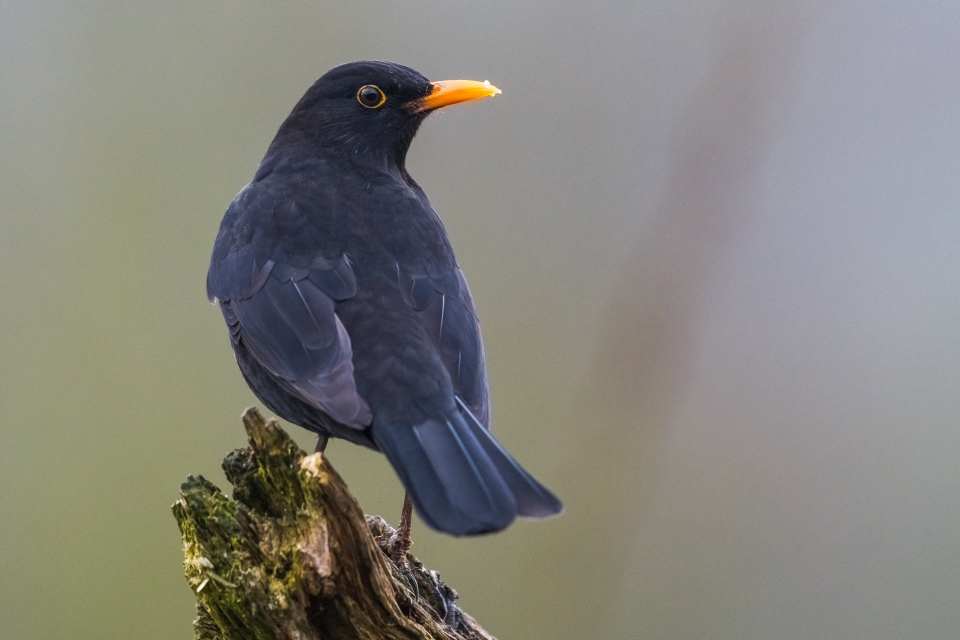
First-winter male Blackbirds may retain worn juvenile wing feathers, giving the wings a paler or browner appearance. However, the colour is uniform and lacks the crisp, silvery edging that is characteristic of Ring Ouzels.

Shape, Posture, and Behaviour
Overall shape (often referred to as “jizz”) can be surprisingly helpful. The Ring Ouzel typically appears more upright and alert, with a proportionately longer tail and a darker-tipped bill. Compared to the Blackbird, it looks slimmer, less rounded, and less domestic.
Behaviour also differs. When flushed, a Ring Ouzel often flies to an exposed rock or tree, where it pauses to survey the surrounding area. A Blackbird usually reacts very differently, diving rapidly into dense cover and disappearing into shrubs or thick vegetation.
Song and Vocal Differences
The song of the Ring Ouzel is often delivered from exposed perches such as rocks or isolated trees. It consists of short phrases that resemble Blackbird song but are delivered more hesitantly and repeated several times. The notes are rich and bubbling but lack the depth and fluid, fluting quality of a Blackbird’s song.
Ring Ouzel Song:
The Blackbird is a confident and enthusiastic singer, heard throughout much of the year. Its song is smooth, flowing, and well-paced, with clear pauses between phrases, often delivered from a prominent perch.
Eurasian Blackbird Song:
Final Tip
If you see a black bird with a bright yellow bill, a clear eye-ring, and white patches or a white chest crescent, particularly in a garden, the bird is almost certainly a Blackbird with abnormal white feathering. While Ring Ouzels do occasionally visit lowland areas, such sightings are genuinely noteworthy and should be supported by multiple identification features.
Related Articles



Ad Space
References
- Lovette, I. et al. (2016) The Cornell Lab of Ornithology, handbook of bird biology. Third edition. Chichester: Wiley. [Accessed 21/12/2025]


