

Species Guide: Long-eared Owl (Asio otus)
Family: Strigidae
The Long-eared Owl, is a medium-sized, widely distributed owl found across much of Europe, Asia, and parts of North America. It is primarily nocturnal and is adapted to hunt small mammals in open terrain while using nearby trees or thickets for daytime roosting and nesting. The species is generally secretive and can be difficult to detect outside the breeding season.
Appearance
Male and Female
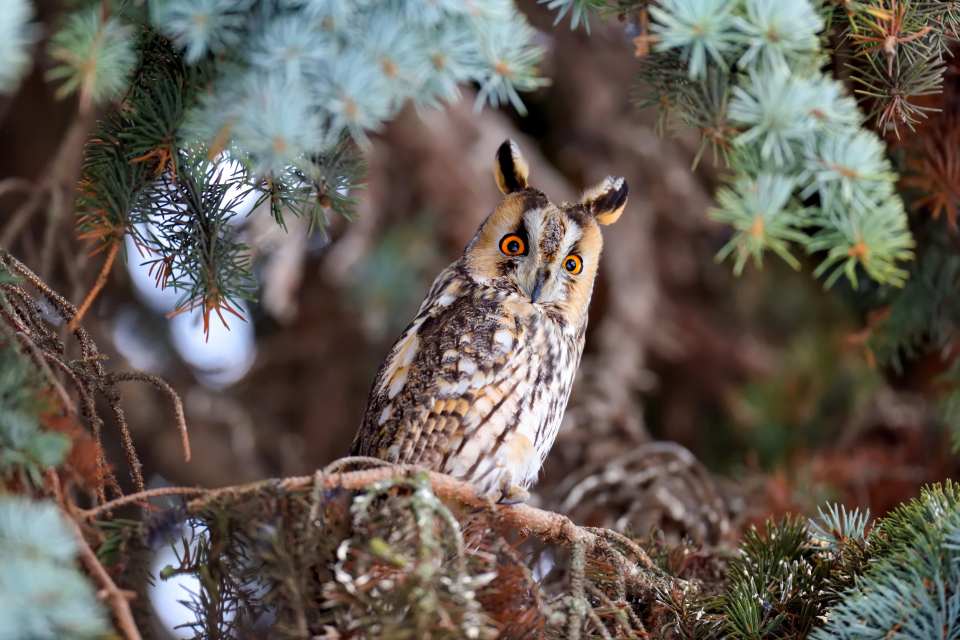
Long-eared Owls are slender, long-bodied owls with prominent ear tufts that are actually feather tufts and not related to hearing. Plumage is a mottled mix of browns, buff, and grey with vertical streaking on the underparts; facial discs are rounded and framed by dark borders with orange to yellow eyes. Females are typically larger and may show darker, denser streaking than males, while males can be slightly paler. Sexual dimorphism in size is present, with females weighing more on average.

Juvenile
Juveniles resemble adults in pattern but are usually paler and fluffier, with less distinct facial markings and shorter ear tufts until they molt into adult plumage. Young birds remain dependent on parents for several weeks after fledging and may be seen near nesting sites during that period.

Diet
The Long-eared Owl is primarily a rodent specialist. Its diet consists mainly of voles, mice, and other small mammals, but it will also take shrews, small birds, bats, larger insects, and occasionally amphibians or reptiles where available. Prey composition varies regionally and seasonally depending on prey abundance. Hunting is typically from a perch or by low, slow flight over open ground.
Habitat
An optimal habitat combines open hunting areas such as grassland, agricultural fields, or meadows with nearby dense vegetation, hedgerows, or woodlands used for roosting and nesting. They will exploit edge habitats, shelterbelts, orchards, parks, and even reedbeds or marsh edges where prey and cover occur close together. Some populations are migratory and may shift habitats seasonally.

Behavior
Activity and Social Behavior
Long-eared Owls are mainly nocturnal. Outside the breeding season, many individuals roost communally in dense conifers or sheltering vegetation, sometimes forming loose winter roosts that concentrate multiple birds. During the breeding season, they become more territorial and secretive around nest sites.
Calls
Vocal activity is concentrated in the breeding season. The male’s most familiar call is a series of soft, resonant hoots used to advertise territory and attract a mate. Both sexes and fledglings produce a range of soft hoots, quavering or rasping calls, and alarm screams when disturbed. Outside the breeding season, they are comparatively silent.
Long Eared Owl Hooting Call:
Long Eared Owl Whine:
Reproduction and Life Cycle
Breeding typically begins in late winter to spring, depending on latitude. Long-eared Owls commonly nest in abandoned nests of corvids, raptors, or other large birds, but will also use tree cavities or artificial nest platforms. Clutch sizes vary with food supply but typically range from 2 to 6 eggs. Incubation is performed by the female and lasts about four weeks; fledging occurs several weeks after hatching, with parental feeding continuing into the post-fledging period. Juveniles disperse at variable intervals, and survival is strongly linked to prey availability and weather conditions.

Biometrics1
| Length | 31-40 cm |
| Wing Span | 86-100 cm |
| Body Weight | 160-300 grams |
| Longevity | 4 Years2 |
Natural Predators
Eggs, nestlings, and occasionally adults may be taken by larger raptors such as goshawks and large owls, by mammalian predators that can access nests, and by corvids when nests are unguarded. Adults are well-camouflaged and rely on concealment, but they may be vulnerable when commuting to and from hunting areas or when mobbed at their nest sites. Predator pressure varies regionally and is one of several factors affecting local breeding success.
Relationship to Humans
Long-eared Owls have a long cultural association with humans. In general, owl species have been interpreted variably as symbols of wisdom, guardianship, or omens in different cultures. Specific folklore items differ by region; in some traditions, the presence of owls is associated with knowledge and protection, in others with bad luck or death. Because Long-eared Owls often nest in shelterbelts, parks, and near farmland, they are encountered by people yet remain cryptic, which has fostered both appreciation and myth. They may also be beneficial to agriculture by reducing rodent pests.
Conservation Status
Globally, the Long-eared Owl is classified as Least Concern on the IUCN Red List because of its very large range and substantial total population. However, local trends vary considerably. Populations in some areas have declined or become more fragmented due to habitat loss, changes in agricultural practice, declines in prey populations, and human disturbance at roosts or nest sites. BirdLife International and national monitoring programs report continuing declines in some mature populations and fluctuations in subpopulations; conservation attention at local scales focuses on retaining a mix of hunting habitat and secure roosting and nesting cover. Managers often recommend protecting roosting woods and hedgerows, maintaining prey-rich foraging areas, and avoiding disturbance at known nest sites during the breeding season.
Global
Conservation Status

Related Articles




Ad Space
References
- Lovette, I. et al. (2016) The Cornell Lab of Ornithology, handbook of bird biology. Third edition. Chichester: Wiley. [Accessed 15/10/2025]


