

Species Guide: Spotted Owl (Strix occidentalis)
Family: Strigidae
The Spotted Owl is a medium-sized owl native to western North America, recognized for its mottled brown and white plumage and its strong association with mature forest ecosystems. There are three widely recognized subspecies: the Northern Spotted Owl, found from British Columbia through parts of the Pacific Northwest into northern California; the California Spotted Owl, occurring in California and adjacent regions; and the Mexican Spotted Owl, inhabiting the desert southwest of the United States and into Mexico. Spotted Owls are known for their specialized habitat requirements and their sensitivity to environmental changes.
Appearance
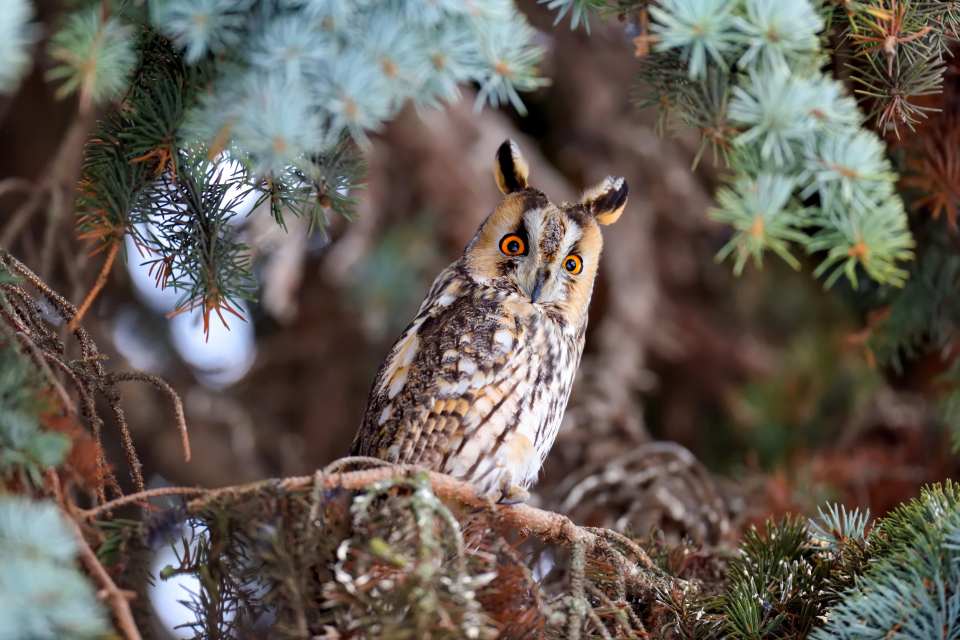
Males generally show the typical brown plumage with white spotting. They are often slightly smaller and lighter in weight compared to females. Females are similar in appearance to males but are usually somewhat larger and heavier. The plumage does not differ markedly from males in overall pattern, though individual variation can occur.

Juvenile Spotted Owls are initially covered in a fluffy white down following fledging. As they mature, adult-like brown and white plumage develops, with spotting becoming more defined over time. Young birds retain a somewhat lighter and softer appearance until fully matured.
Diet
Spotted Owls are carnivorous and primarily hunt at night. Their diet consists mainly of small to medium-sized mammals, including flying squirrels, woodrats, mice, and voles. They also take other small animals such as rabbits, bats, birds, reptiles, amphibians, and large insects when available. Hunting typically occurs by perching quietly and then swooping down on prey with their sharp talons.
Habitat
Spotted Owls are strongly associated with mature and old-growth forests. These environments provide dense canopy cover, large trees for nesting and roosting, and abundant prey. They inhabit mixed coniferous and pine-oak forests, wooded ravines, and canyons. Mexican Spotted Owls may also use chaparral and pinyon woodlands with steep terrain. Spotted Owls typically avoid open areas and highly disturbed landscapes.

Behavior
Spotted Owls are primarily nocturnal, though adults may hunt during daylight in the breeding season. They use a “sit-and-wait” strategy, gliding silently from perch to capture prey. Their large wings allow quiet flight through dense forests. Spotted Owls maintain large territories and exhibit high site fidelity, often returning to the same nesting area over many years. Outside the breeding season, they are largely solitary.
Calls
Their vocalizations include a series of hoots, often described as hesitant or ethereal. These calls serve territorial and communication functions. Contact calls and alarm calls also form part of their acoustic repertoire, with variations in pitch and rhythm.
Spotted Owl Call:
Life Cycle
Spotted Owls typically form monogamous pairs that may last for many years. Breeding usually occurs in late winter and early spring. Nests are placed in tree cavities, broken tops, rock crevices, or existing nests from other species. Females lay one to four eggs, with two being most common. Eggs are incubated for roughly 28 to 32 days. Juveniles leave the nest after about 34 to 36 days and remain near their parents for several weeks before dispersing. Spotted Owls generally reach sexual maturity around one to two years of age.
Biometrics1
| Length | 40-48 cm |
| Wing Span | 100-120 cm |
| Body Weight | 500-760 grams |
| Longevity | 10-15 Years |
Natural Predators
Adult Spotted Owls have few natural predators due to their size and nocturnal habits. However, larger raptors such as Great Horned Owls and Northern Goshawks may occasionally predate on them. Red-tailed Hawks may pose a threat in some regions as well. Barred Owls, a closely related species with expanding range, compete with Spotted Owls for habitat and resources, indirectly affecting their survival.
Relationship to Humans
Spotted Owls have long been a symbol of mature forest ecosystems and are often associated with wisdom in cultural narratives. Owls in general appear in many fables and myths, representing both wisdom and mystery in various traditions. Their presence attracts bird watchers and nature enthusiasts, contributing to ecotourism in forested regions. However, restrictions on logging to protect Spotted Owl habitat have generated economic and political controversy, particularly in regions where wood products industries are significant.
Conservation Status
Spotted Owls are considered vulnerable with a decreasing population trend. The International Union for Conservation of Nature lists the species as near threatened, and several subspecies have formal protection under national legislation. In the United States, the Northern and Mexican Spotted Owls are listed as threatened under conservation laws. Habitat loss due to logging and land conversion is the principal threat, and competition from Barred Owls exacerbates their decline. Populations have declined substantially over recent decades, prompting significant conservation efforts focused on habitat protection and management.
Global
Conservation Status

Related Articles




Ad Space
References
- Lovette, I. et al. (2016) The Cornell Lab of Ornithology, handbook of bird biology. Third edition. Chichester: Wiley. [Accessed 22/12/2025]
CITATIONS
- Dunning, John B. Jr., ed. (1992). CRC Handbook of Avian Body Masses. Boca Raton: CRC Press. ISBN 978-0-8493-4258-5. [Accessed 22/12/2025] ↩︎


